
Why Does Your Skincare Turn Into Little Eraser Crumbs?
What causes tiny skincare product crumbs, what the science says about pilling, and how to troubleshoot without compromising sunscreen.
4 min read By Dr. Lurié Skincare Editorial Skincare

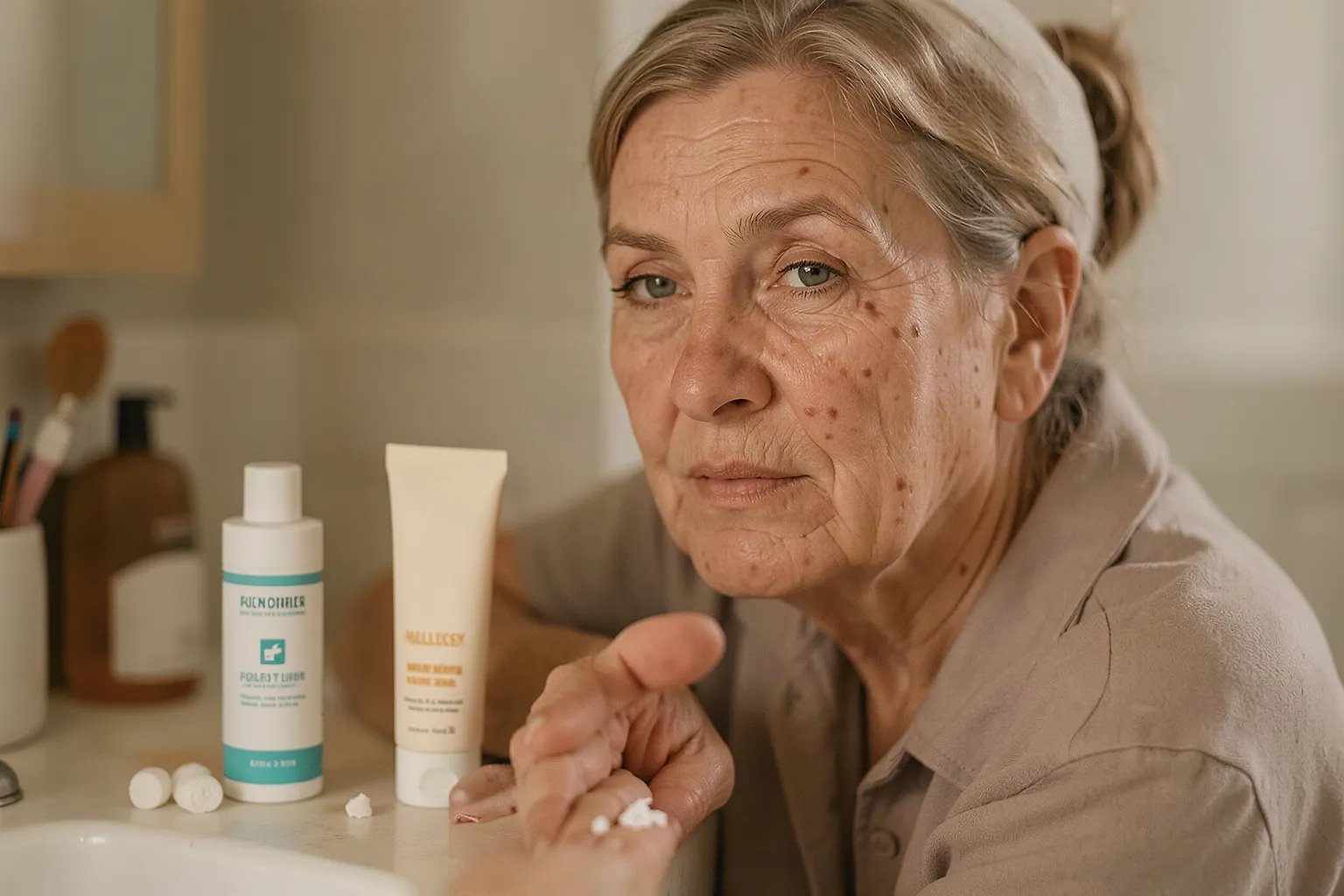
The serum felt lovely. The moisturizer went on smoothly. Then, just as you were about to leave, you smoothed sunscreen across your cheek and found tiny gray-white rolls on your fingertips.
They look like the crumbs from a pencil eraser. You wonder whether your face is shedding, your products are spoiled, or the sunscreen has decided not to cooperate.
The phenomenon has a name: skincare pilling. The explanation is usually less alarming—and considerably more interesting—than it looks.
What are the little rolls?
Cosmetics are mixtures. Some ingredients remain on the surface as creams, gels or films after application. Add another formula, then rub repeatedly, and material from those layers can sometimes gather into visible particles.
You cannot identify the chemical composition of a pill just by looking at it. A little surface skin might join the mixture, but tiny rolls appearing while you apply a product do not prove that you are exfoliating. Nor do they necessarily mean the bottle has gone bad.
The researchers put pilling to the test
A 2024 study in Skin Research and Technology looked at how cosmetic layers pill on the face. Among 528 women aged 20–49, 217 developed some pilling under the researchers' application conditions. The authors found more pilling with sunscreen over a base product than with foundation over that same base. Rubbing techniques produced more pilling than gentler application.
These were particular formulas under controlled study conditions, not a universal verdict on all sunscreens or on the skin of adults over 50. The study also involved authors with cosmetics-industry affiliations. It supports the importance of formula interaction and application method; it does not identify one villain ingredient in every product.
Why sunscreen gets the blame
Sunscreen is often the final layer, which means it receives the last round of rubbing. If the layers beneath have formed films, friction can disrupt the finish. This is a cosmetic observation—not a direct test of how much ultraviolet protection remains.
Still, patchy application is worth addressing. Do not fix pilling by using less than the recommended amount of sunscreen, diluting it with moisturizer or simply skipping sun protection. A broad-spectrum SPF 30 or higher product that you can apply evenly is more useful than one that looks elegant in its bottle but behaves badly on your face.
The five-minute detective test
Start with fewer layers while keeping your sunscreen. On another morning, apply the same products with less rubbing, spreading each one gently. Let each layer settle as instructed by its maker; no single scientifically established waiting time works for every formula.
If the problem continues, change one product at a time. A different moisturizer texture beneath your regular sunscreen may make the combination more comfortable. Or you may prefer a different appropriate sunscreen formulation. Do not repeatedly scrub the skin in frustration; irritation is not a good trade for smoother-looking makeup.
Three myths to leave on the bathroom counter
'It means nothing absorbed.' No. Pilling is a surface phenomenon and cannot measure absorption of an active ingredient.
'It's always silicone.' Not necessarily. An ingredient list cannot by itself predict how a completed formula will interact with another.
'Exfoliate harder.' That can make sensitive or dry skin more uncomfortable. Adjusting friction and product compatibility is a more sensible first experiment.
When it may be something else
If flakes appear when you have used no products, or if you have persistent scaling, pain, redness or recurring rashes, do not assume that the only issue is cosmetic pilling. A clinician can help distinguish routine dryness from irritation or a condition that deserves treatment.
The little rolls appearing only as you rub on the last layer are a useful clue, not a diagnosis.
A more useful routine
The ending is less expensive than the mystery: often you need fewer layers, gentler handling or a different combination—not a completely new shelf of skincare. The best routine is the one you can apply consistently, comfortably and with adequate sun protection.
Sometimes the face simply prefers less friction.